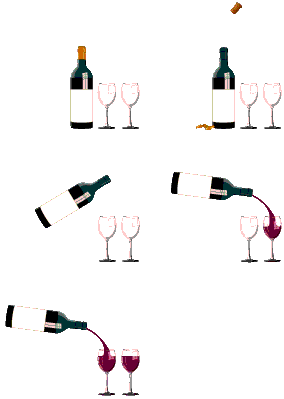
Wine Info
Toasting
Recommendations
There are no specific rules for toasting, though the club recommends the
following guidelines:
1) You should always stand when offering a toast unless it is a small informal
group.
2) Never drink a toast or stand to a toast, when it's being offered to you.
3) If you are toasted, afterwards you should always stand up and respond to the
toast, even if it is to say a simple thank-you.
4) Always allow the host to toast a guest of honor first. If you believe that
host is not intending to, then request the host's indulgence before performing a
toast yourself.
5) Despite what you might see elsewhere, is is considered impolite to signal for
quiet for a toast by rapping on a glass.
6) When toasting one lightly clinks one's glass with the glasses of the guests
on either side of oneself and then raise one's glass with a warm smile, nod to
other guests.
Toasting History
Toasting can be traced back to the Greeks as early as the 6th Century
B.C. Due to the political climate many people were afraid of being
poisoned. Toasting the health of their friend's was a practical way to
assure them that the wine was safe!
The Romans, followed with the same philosophy, hence the practice of
toasting became more popular especially with the many Roman parties.
The term toast is derived from the Roman practice of placing a piece of
burnt bread into the wine. The charcoal from the burnt toast would
reduce the acidity of some of the lesser wines making them more
drinkable. The Latin "tostus" means roasted or parched, this eventually
became to refer to the practice of drinking itself.
Toasting is historically done holding the glass in right hand. This is
so that, when two foes toast each other they can't use their daggar/sword/knife
hand (usually the right) for any mischief.
Ship Launching
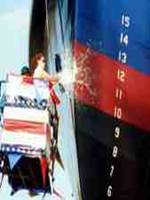
Many People have seen a ship being launched using a bottle of Champagne.
The history of breaking a bottle of wine over a ship's bow was dates
back to the about the late 17th century (initially wine then champagne).
The British Navy originally baptised their ships with a "standing cup"
of precious metal, which was afterwards thrown overboard. Unfortunately
with the increased production of ships during for the increasing British
Empire the cost became extensive, hence the use of Champagne instead.
The 'Titanic' was launched by the White Star Line on Wednesday, May 31,
1911 in front of all the dignitaries, and over 100,000 spectators
watching the event. Lord Pirrie (chairman of Harland and Wolff) simply
gave the calm order to the launch foreman. There was no formally naming
ceremony, no bottle of champagne broken across her bow and the Titanic
was never christened. So became her fate.
Naval Toasts
Royal Navy use the following toasts whilst dining at sea in the
Officers' Wardroom (mess). It is traditional for the youngest Officer
present to make the toast.
Sunday - Absent Friends
Monday - Our Ships at Sea
Tuesday - Our Men
Wednesday - Ourselves
Thursday - Bloody War and a Sickly Season (Hence more rapid promotion)
Friday - A Willing Foe and Plenty of Sea Room (in which to defeat them)
Saturday - Sweethearts and Wives (Which typically there is the added
unofficial comment "May they Never Meet!")
Wedding Toasts
Wedding toasts can vary significantly as to who makes them and when they
should occur. Essentially the toast is also governed by whom is making
the speeches. In the end, it is up to the couple as to what they wish.
The order of speeches is traditionally as follows:
The Father of the Bride
The Bride's father is the first to speak as the 'giver away' and should
keep his speech fairly brief. He should typically talk about raising his
daughter and can include anecdotes about her childhood, while not giving
her too much cause for embarrassment. The basic points to cover include:
- Thanking the guests for coming, especially any overseas/interstate
one's or others who may have made a special effort to be there.
- Say how proud he is of his daughter and her choice of husband.
- Welcome the Groom to the family.
- Conclude by proposing a toast to the Bride and Groom.
The Groom
The Groom replies to the toast on behalf of the Bride and himself. The
Groom's speech may be a little longer than that of the Bride's father
and he should talking about his wife and their future together. The
other key aspect of the Grooms speech is that, it is full of thanking!:
- Thanking the Bride's father/parents for the toast and generosity in
hosting the wedding.
- Thanking the Bride's father/parents (and the Bride herself!) for
allowing him to marry her.
- Thanking his own Parents, for everything they have done for him.
- Thanking the guests for attending and for their gifts.
- Thanking everyone who has helped with the day, including the Best Man
and Groomsmen.
- Thanking the Bridesmaids and Pageboys, concluding the speech by
proposing the toast to the Bridesmaids.
The Best Man
The best man makes the final (and most anticipated) speech of the
evening. His speech is usually a little longer than the others and
should be full of anecdotes and humorous stories about the groom, whilst
taking into account the audience. It should also cover:
- Thanking the groom on behalf of the bridesmaids.
- Thank anyone who has given him particular help.
- Reading out any telemessages.
- Congratulate the newly-weds.
- Propose the Final Toast of the Evening to the newly wed Bride and
Groom.
Other Considerations
- If the Bride wishes to also have a speech, it is recommended that she
speak after the Groom unless it has been fully rehearsed. Co-ordinating
a speech is difficult normally, let alone when both people are flowing
with emotions.
- If the Father/Parents of the Groom also wish to say a few words, their
speech should occur after the Father of the Bride.
- The Timing of speeches usually is key to an event and typically occurs
in between the Wedding meal courses, nearer the end of the evening.
- Another style is to cut the Wedding cake at the end of Main course,
having all the speeches after it is cut. This way the cake should be
ready for distribution to all the guests at the end of all the speeches.
- Glasses should be filled with Champagne before the speeches start.
Usually a top-up is required before the Best Man's Speech.