
Wine related articles
Grape Growing - History and Techniques – (Part One)
Caesar - October 7,
2003
The Fillossera, or Public
Enemy Number One
The most fearful enemy of the grape grower is the fillossera, a vine
parasite of the Phylloxeridae family. In fact, between the end of the
1800s and the beginning of the 1900s, the vast majority of the Italian
vineyards was destroyed by this parasite.
This miniscule insect can cause huge damage to the root system of European vines (vitis vinifera e vitis silvestris). The filossera stings the roots of the vine generating malformations and knots which compromise the regular function of the roots and, eventually, cause its disintegration.
To the American vines though (vitis rupestris, vitis berlandieri e vitis riparia), the fillossera causes just limited damage to the aerial part of the plant without hurting the roots.
These characteristics brought about the identification of the American varieties that are most appropriate to be used as recipient for the European varieties, therefore generating vineyards that are much more resistant to such a terrible menace. To start new vineyards one plants grafted vines, made by an American root system resistant to fillossera as recipient, and an European aerial portion (the grafted variety).
Vineyard Cultivation in the World
|
|
|
|
|
|
|
|
|
|
|
Hilly vineyards at different times of year |
|
|
|
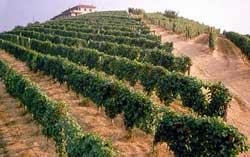
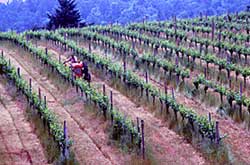
Currently grapes are grown in about 50 countries worldwide, but the vast majority of vineyards are located in Europe. In fact, the "old" continent is way up at the top accounting for 80% of global production. On the other end, the whole American continent produces the 14%, Africa the 4%, while Asia and Australia together account for 1% of total production.
Italy in particular, is the country that grows the gratest number of grapes on the planet. The most important production regions are Veneto, Piedmont, Emila-Romagna, Tuscany, Apulia and Sicily, but vineyards are cultivated throughout all the Italian regions with excellent results and good quality level.
Italy has a great nursery tradition, providing grafting materials to several foreign countries all over the world.
In addition, long centuries of grape growing left Italy with many varieties of vitis vinifera that represent a precious treasure for the Italian wine regions. In fact, as opposed to vines originating in other countries, which are known as 'international vines' because of their adaptability to different ecosystems, many Italian varieties do not fare well outside their native region. This ensures that the production of great Italian wines can not be reproduced elsewhere in the world.
The plants in a vineyard last about 40-50 years. The first 7-8 years the young vine starts out being totally unproductive, then begins a growing production until it stabilizes for the next 20-25 years. Production then diminish gradually for the last 10 years until, finally, the vine dies.
In reality, vines could live up to 100 years. The need for hybrids made with roots from the American vines, created vineyards that are much more resistant to the fillossera, but at the same time have a definitely shorter life span.
|
|
|
Glorious Tuscan Vineyards in Fall |
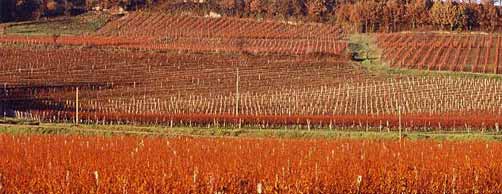
Methodologies for Starting
a Vineyard
There are various methods of growing grapes, some of which are rooted in
ancient times. Today however, there are two systems that are used
mostly, the graft called doppio
spacco inglese, or "English double-split" and the "bud" (a
gemma) graft.
The first method consists of preparing the new plant using two elements, the root base and the grape variety. With the second system instead, the bud is grafted to a root system already planted in its final destination.
By starting a vineyard, one creates a mini-ecosystem which consists of one or more grape varieties grafted on to American roots, the area weather, the composition of the soil and a series of growing techniques.
All and any of these elements contribute to the characteristics of wine produced.
We close here with the first part of our brief history of the vine. In the next article we will be looking more deeply into the different varieties of grapes as well as the various growing techniques.
The typology of vine growing technique is tightly linked to the totality of environmental conditions where the vines are planted. The growing method chosen by the vintner is the technical strategy that makes for optimal integration of the vineyard within the existing environment.
Before setting up a new vineyard, the grower has to be clear about the kind of wine that he or she wants to produce, as well as about the evolution the vines will undergo and just which sensations the wine produced should stimulate in the future wine drinker.
This initial planning phase will eventually materialize in the techniques applied to starting up the successful vineyard. A successful vineyard is one which is able to consistently withstan its environment so that the vines integrate, develop and flourish in their surroundings.
The environment is the factor that will most greatly affect the final result, but the development and growth of the vines are an integral part of the productive process. Thus, the grower is forced to intervene at different times to affect production and solve possible problems. This way, one creates the "history" that makes each vineyard unique and generates the individual peculiar aspects and character that are typical to every quality wine .
The three elements upon which it is possible to act so as to improve the quality of the grapes are the right choice of the vineyard eco-system, the vineyard growing technique, and the type of vine planted.
The Grape Growing Technique
| The growing technique is extremely important and includes the optimal management of various factors such as: |
|
|
|
|
|
|
Cordone Speronato, or Rammed Cord |
|
|
|
|
|
|
|
|
Guyot Alto, or Tall Guyot |
|
|
|
|
|
|
|
|
Pergola Trentina, or |
|
|
|


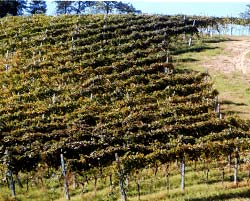
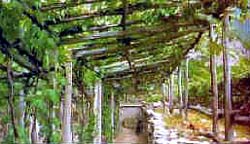
Italy has developed a variety of pruning and grape growing systems based upon historic techniques, some of which are traceable back to the ancient Greek and Etruscan peasants.
In fact, Italy counts on more types of grape growing methods than does any other country in the world, ranging from low Greek-style pole to the Etruscan tree form, where the grape vines climb up tall trees, much as tropical vines do.
Perhaps the most used type of grape growing can be classified into three main categories:
1. Vertical structure or development, which includes the following techniques:
1. Pole,
2. Guyot,
3. Capovolto (Upside down) or Cappuccina,
4. Cordone Speronato (Rammed Cord), and
5. Sylvoz.
2. A ricadere (fall back) with vertical structure, which includes the following techniques:
1. Umbrella,
2. Guyot Alto (Tall Guyot),
3. Casarsa, and
4. G.D.C.
3. Reclined or horizontal development, which includes the following techniques:
1. Pergola Trentina (Pergola Trento style),
2. Pergoletta Emiliano-Romagnola (Little pergola Emilia Romagna style),
3. Pergoletta Capucci (Little pergola Capucci style),
4. Sistemi Campani (Campania region systems),
5. Raggi (Arrays) or Belussi, and
6. Tendone (Big Top).
Notwithstanding the large varieties of systems inherited from centuries of grape growing practice, some forms that are easier to prune and friendlier to mechanical harvesting have become more popular in recent years. They are:
1. Cordone Speronato Orizzontale (Rammed Horizontal Cord),
2. G.D.C., and
3. Duplex.
The Eco-System
In order to produce quality grapes, the ecosystem remains the most
important complex of elements upon which the grower can intervene, or
better, select and bet upon when starting a vineyard. In fact, the
growing techniques alone have very limited effects if there is no
compatibility with the environment.
Hill and mountain fields have always been ideal for grape growing.
Tracing the results of centuries of grape growing, one can safely state that great wines are born in hilly or mountainous vineyards all over the world, thoughthere are some notable exceptions such as Napa Valley, California where unique eco-systems provide an extremely favorable environment.
A wide difference between day and night time temperatures during the ripening season is essential to improving the grape quality. Vines growing on hills or mountains take special advantage of variations excursions due to the altitude and major exposure to the range of weather conditions.
Fields located at higher elevations receive more light, thus taking advantage of a more desirable climate as well as of drier soil during the ripening phase. These factors contribute to inhibiting or even eliminating completely the vegetative development, which favors the concentration of sugars, aromas, polyphenols and other active substances that concentrate in the grape.
Vine Variety
In addition to the eco-system and grape growing techniques, the variety
of vine chosen is the third element that affects the quality of the
final enological product.
Below we provide some examples of grapes that are ideal for the production of specific types of wine.
| Vines suitable to production of sparkling wines and spumante wines: |
|
| Vines suitable to production of fresh, fruity and light wines: |
|
| Vines suitable to production of wine that ages gracefully for many years: |
|
Final Considerations
It is very important to remember that though some traditional growing
techniques may be deemed imbalanced or inefficient based upon modern
evaluation methods, the specific context from which these methods
evolved should not be overlooked.
Each type of growing technique is the expression of the enological history of the territory and the ways growers have molded the vines for centuries to best produce fine wine within specific environments and according to local taste and requirements.
Looking at the Italian production from this perspective, it becomes easier to understand why in some regions growers continue to stick to traditional growing techniques rooted in the past.
Even though the ratio of production-per-acre may be so scant as to horrify modern wine entrepreneurs, the variety of growing techniques used in Italy contributes substantially to the rich and appreciated variety of its enological production.
The need for constant and abundant production, along with the intensive cultivation of the fields available and the request for wines that have a shorter production-to-consumption cycle, sometimes validates and promotes growing systems that would arguably be better abandoned if the measuring stick were based only upon quality and variety.
1,2,3,4,5,6,7,8,9,10,11,12,13,14,15,16,17,18,19,20,21,22,23,24,25,26,27,28,29,30
31,32,33,34,35,36,37,38,39,40,41,42,43,44,45,46,47,48,49,50,51,52,53,54,55
56,57,58,59,60,61,62,63,64,65,66,67,68,69,70,71,72,73,74,75,76,77,78,79,80,81