
Wine related articles
The Truth About Sulfites – Chemical Lies in Wine (First of Two
Parts)
William Campbell for
The Japan
Time -
September 22, 2004
It is received wisdom that the sulfite additives in American red wines cause many drinkers to have headaches, and that the health concerns over these 21st-century chemicals are so great that wines tainted by them are required to carry an explicit "Contains Sulfites" warning.
|
|
|
|
|
Winemaker weighing out sulfites for a 5,000 liter tank |
|
|
|

In reality, however, nothing could be further from the truth. As is often the case when it comes to alcohol and public policy in North America, pseudoscientific groups and temperance fanatics dominate the debate. The urban myths surrounding wine are now so pervasive that cynical marketers are even using them to fob off markedly substandard wines to trend-conscious but unsuspecting Japanese consumers under the guise of a "traditional winemaking" revival. Although you'd never know it from the tone of the debate, sulfites are actually an organic compound that nature uses to prevent microbial growth. They are found on grapes, onions, garlic and many other growing plants.
Nearly all organisms, including yeasts and humans, produce sulfites as well (they are a natural byproduct of amino acid metabolism).
As chemicals go, sulfites are multitalented: In addition to preventing spoilage by inhibiting the growth of molds and bacteria, they also act as antioxidants. A cut pear left in the sun will quickly turn brown and then rot, but if first exposed to sulfur dioxide (the sulfite that is most commonly used in wine-making), it will remain brightly colored and dry without decaying. The age-old method of burning a bit of sulfur in a box filled with freshly cut fruit before setting the fruit out in the sun to dry, as in "sulfuring," is still practiced around the world today, including by my own parents in California's wine country.
It is unclear how early winemakers discovered the preservative qualities of sulfur, but it is well-documented that by 100 B.C. Roman winemakers often burned sulfur wicks inside their barrels to help prevent the wine from spoiling.
In the 16th century, Dutch traders found that only wine treated with sulfur could survive the long sea voyages without it turning to vinegar, and sulfite additions quickly became a universal winemaking tool in Europe.
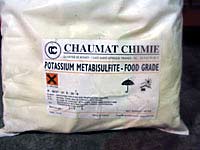
Modern winemakers typically add sulfites immediately after crushing, again during barrel aging, and then once more just before bottling. Although the same form is used (potassium metabisulfite dissolved in water), the purpose at each point is different.
The initial add is usually made as the grapes are crushed, with the winemaker typically adding enough to give a final sulfur dioxide concentration in the juice of 50 ppm (parts per million). This stuns any mold and bacteria naturally found on the grapes, and allows the less sensitive wine yeasts a chance to get a substantial head start over non-wine yeasts and other noxious organisms.
As the first round of sulfites is usually absorbed during fermentation, a second round is added just before the wine is put down to age in the barrel. This helps prevent the growth of film yeasts (which occur on the surface and are responsible for sherry) and acetic bacteria, which turn wine to vinegar. Unsurprisingly, wines made without sulfite adds at the above two points are often an amalgamation of unusual odors and flavors.
The final sulfite add occurs just before bottling (typically 30 ppm-free sulfur dioxide). Over time, oxygen in the bottle combines with the wine's tannins and color compounds, and ultimately with its alcohol, resulting in a "dead" wine. Sulfites oxidize more rapidly than any other of these wine components, so in a sense they sacrifice themselves to protect the wine and extend its ageability.
Given the long history of sulfite additions to wine and many other food products, where did the health warning come from? Approximately 0.25 percent of North Americans have serious sulfite allergies, including one unfortunate man who is reported to have died after eating at a salad bar where the salad was sprayed with a 2000 ppm "keep fresh" sulfite solution that was commonly used in the 1970s (remember, bottled wine typically contains 100 times less than this amount).
|
|
|
|
|
Industrial sulfites from French wine supplier Chaumat Chimie |
|
|
|
While the Food and Drug Agency (FDA) was pondering sulfite-labeling requirements, fanatical anti-alcohol activists saw this as a golden opportunity to associate wine consumption with a health scare. They were able to successfully pressure the FDA into requiring a prominent "Contains Sulfites" warning on every bottle of wine made or imported into the United States after 1986. (Oddly, the fact that raisins, soy sauce, pickles, fruit juices and many other foods can contain as much as ten times more sulfites than wine didn't seem to bother the temperance lobby.)
Despite the fact that virtually every winemaker in the world uses sulfites, the sudden appearance of the warning on United States wine labels led to the mistaken belief that U.S. wines had "extra chemicals." (Australia requires a small "Preservative (220) Added" note on the label; the EU requires no labeling.)
The wine trade abounds with stories of customers who claim that "the sulfites in U.S. wines give me headaches that I never get with European wines." Some wealthy, but certainly not well-educated, customers even claim to buy Bordeaux in Europe and then have it hand carried back into the U.S. since "everyone knows that the Bordeaux imported to the U.S. has sulfites added to it that they don't use in Europe."
It is well-known that some people do experience headaches from drinking even small amounts of red wine, although the exact cause is unknown. What is certainly true is that white wines are bottled with substantially higher sulfite levels than reds, because they lack the tannins and color compounds of red wines. Whites need more antioxidant "help" to survive in the bottle.
Therefore anyone who can drink white wines (or eat dried fruit for that matter) but who claims that the sulfites in red wines give them headaches is propagating a falsehood. Interestingly, some winemakers and Japanese importers have jumped on this bandwagon and are trying to position so-called "no sulfite" wines as the latest return-to-traditional-winemaking ploy (if by "traditional" they mean pre-Roman, then I guess I might grant them the point). Of course, since yeasts produce sulfites naturally during fermentation, there is no such thing as a "sulfite-free" wine. The FDA does, however, allow wines with final concentrations of less than 10 ppm to drop the "Contains Sulfites" label. In this case, many winemakers include a "No Added Sulfites" designation, which leads many people to falsely conclude that the wine contains no sulfites at all.
Could centuries of traditional winemaking practice really be wrong? Or could the new wave of "no added sulfite" wines possibly represent some new leap forward in technology? We recently attended two technical tastings to see for ourselves under carefully controlled double-blind conditions where the participants are not told what the test is going to be. We tasted sulfured and unsulfured versions of the same wines made by two Italian winemakers who were honest enough to bottle them separately and let people judge for themselves.
The three pairs of white wines tasted were the 2002 and 2003 Sassaia from Angiolino Maule and the 2000 Oslavje from Radikon (regular and "no added sulfite" versions of each). The differences were dramatic: In all three cases what were later revealed to be the unsulfured versions were substantially browner in color and smelled distinctly of sherry and cooked green beans. And while the regular versions were bright and fresh in the mouth, the "no added sulfite" versions tasted of caramelized sherry and were noticeably more brutish and astringent.
Sometimes one really needs to work hard to detect differences between two similar-tasting wines, but this certainly wasn't the case this time. All tasting panel members described the unsulfured wines as either slightly or well past their peak, and one blind-taster speculated that the unsulfured wines had been stored in a car trunk all summer, while another guessed that the 2002 Sassaia pair was actually the same wine from two vintages that were a decade apart.
While one taster said that her company would keep importing unsulfured wines to Japan "to meet market demand," there was no doubt which version everyone in the room would prefer to be drinking at home.
1,2,3,4,5,6,7,8,9,10,11,12,13,14,15,16,17,18,19,20,21,22,23,24,25,26,27,28,29,30
31,32,33,34,35,36,37,38,39,40,41,42,43,44,45,46,47,48,49,50,51,52,53,54,55
56,57,58,59,60,61,62,63,64,65,66,67,68,69,70,71,72,73,74,75,76,77,78,79,80,81